
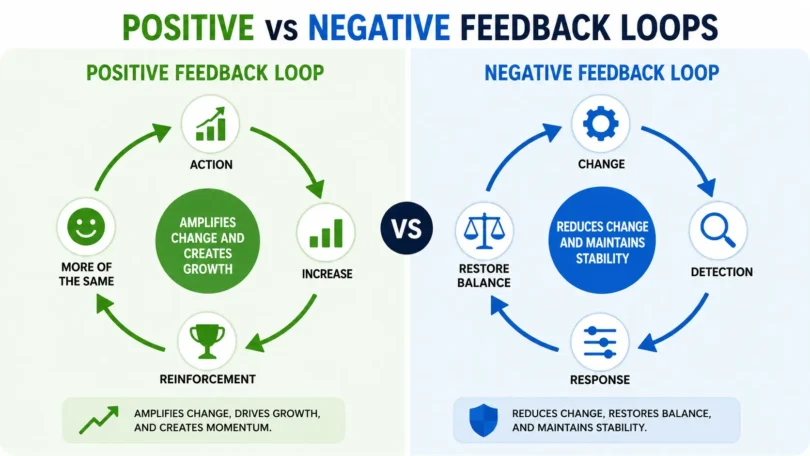
Have you ever noticed how small actions in your life can slowly turn into powerful habits or patterns over time? Whether it is building confidence, improving productivity, or even managing stress, many of these changes are driven by invisible systems called feedback loops. A feedback loop is a continuous cycle where the results of an action influence future behavior, either by reinforcing it or balancing it.
In psychology, biology, and everyday life, feedback loops help explain why some behaviors grow stronger while others stay stable or get corrected. Positive feedback loops amplify change and create momentum, while negative feedback loops reduce change and maintain balance. Understanding the difference between these two systems can help you better understand your habits, emotions, decisions, and even the way your body functions.
In this article, we will explore the key differences between positive and negative feedback loops, how they work in real life, and why they are essential for personal growth, stability, and long-term success.
What Is a Feedback Loop?
A feedback loop is a process in which the output of a system returns to influence the same system again. In simple terms, feedback loops happen when actions create results, and those results affect future actions. This cycle can either strengthen a behavior or reduce it over time. Feedback loops are found in many areas of life, including psychology, biology, business, technology, and personal development.
Understanding feedback loops can help people recognize patterns in their habits, emotions, and decisions. Whether the loop encourages growth or maintains balance, it plays an important role in shaping outcomes and behaviors.
Definition of a Feedback Loop
A feedback loop is a continuous cycle where the results of an action are fed back into the system to influence future behavior or performance. In a feedback loop, every action creates a reaction, and that reaction affects what happens next.
There are two main types of feedback loops:
- A positive feedback loop increases or reinforces change.
- A negative feedback loop reduces change and helps maintain stability.
For example, when someone receives praise for completing a task, they may feel motivated to continue working hard. This creates a positive feedback loop because the reward strengthens the behavior. On the other hand, a thermostat controlling room temperature is a negative feedback loop because it works to keep conditions stable.
Feedback loops are closely connected to concepts such as Positive Reinforcement, Negative Reinforcement, and Homeostasis.
How Feedback Loops Work
Feedback loops work through a repeating process that includes actions, results, and responses. The cycle usually follows these basic steps:
- An action or input occurs.
- The system produces a result or output.
- The result is observed or measured.
- The feedback influences future actions.
This repeating cycle can continue indefinitely. In a positive feedback loop, the results amplify the original action. In a negative feedback loop, the results reduce or correct the action to maintain balance.
For example, in habit formation, exercising regularly may improve energy and mood. Feeling healthier then motivates a person to continue exercising, creating a self-reinforcing cycle. In contrast, the human body uses negative feedback loops to regulate temperature. If body temperature rises too high, the body sweats to cool itself down and restore balance.
In Behavioral Psychology and Systems Theory, feedback loops are considered essential for understanding how systems adapt, respond, and evolve over time.
Why Feedback Loops Matter in Everyday Life
Feedback loops influence many parts of daily life, often without people noticing them. They affect habits, emotions, relationships, productivity, learning, and even financial decisions. Recognizing these patterns can help people improve positive behaviors and reduce harmful ones.
Positive feedback loops can encourage motivation, confidence, and personal growth. For example, learning a new skill may lead to better performance, which increases confidence and encourages continued learning. Over time, this cycle can produce long-term success.
Negative feedback loops are equally important because they help maintain control and stability. Budgeting money, correcting mistakes, and managing stress are all examples of balancing systems that prevent problems from growing worse.
Feedback loops also shape online behavior and social interactions. Social media platforms often use engagement systems that reward likes, comments, and shares, encouraging users to spend more time online. These behavioral cycles demonstrate how feedback mechanisms can strongly influence human actions and decision-making.
By understanding feedback loops, people can become more aware of the patterns driving their lives and make smarter choices that support healthier habits, emotional balance, and personal development.
Positive Feedback Loop vs Negative Feedback Loop
Understanding the difference between a positive feedback loop and a negative feedback loop is essential for recognizing how systems, behaviors, and habits develop over time. Although the words “positive” and “negative” may sound emotional, these terms actually describe how a system responds to change. One type increases or amplifies change, while the other works to reduce or control it.
Both feedback loops play important roles in psychology, biology, technology, business, and everyday life. They influence the way people think, act, learn, and respond to different situations.
Definition and Meaning of Positive Feedback Loop
A positive feedback loop is a process that reinforces or increases a change within a system. In this type of loop, the output strengthens the original action, causing the cycle to continue growing stronger over time.
Positive feedback loops create self-reinforcing patterns. When an action produces a rewarding or beneficial result, people are more likely to repeat that action again. This repeated behavior can lead to continuous growth, motivation, or acceleration.
For example, when someone exercises regularly, they may feel healthier and more energetic. Those positive results increase motivation to continue exercising, creating a cycle of improvement. This is a common example of a positive feedback loop in habit formation and self-development.
In psychology, positive feedback loops are closely related to Positive Reinforcement, where rewarding outcomes strengthen behavior patterns.
Definition and Meaning of Negative Feedback Loop
A negative feedback loop is a process that reduces or counteracts change in order to maintain balance and stability. Instead of increasing the original action, the system responds by correcting or limiting it.
Negative feedback loops are essential for regulation and control. They help systems avoid extremes and return to a stable condition when disruptions occur.
One of the best-known examples is Homeostasis in the human body. When body temperature rises, the body sweats to cool down. If the temperature becomes too low, the body shivers to generate heat. These responses help maintain balance and prevent harmful changes.
In everyday life, negative feedback loops can also help people manage spending, control emotions, and correct mistakes. These balancing mechanisms are important for long-term stability and healthy decision-making.
Main Differences Between Positive and Negative Feedback Loops
The primary difference between positive and negative feedback loops is how they respond to change.
A positive feedback loop amplifies change and pushes the system further in the same direction. A negative feedback loop reduces change and works to restore balance.
Positive feedback loops often lead to growth, acceleration, and increased momentum. Negative feedback loops focus on control, stability, and regulation.
Another important difference is the outcome of the cycle. Positive feedback loops can create rapid improvement or rapid decline depending on the behavior being reinforced. Negative feedback loops usually prevent systems from becoming unstable or extreme.
For example, saving money consistently can create a positive feedback loop because financial progress motivates continued saving. In contrast, a spending limit or monthly budget acts as a negative feedback loop because it controls excessive spending and maintains financial balance.
Reinforcing Change vs Stabilizing Change
Positive feedback loops reinforce change by strengthening behaviors, reactions, or processes. The more the behavior is repeated, the stronger the cycle becomes. This can be useful for developing healthy habits, building confidence, and improving performance.
However, reinforcing change is not always beneficial. Bad habits can also become stronger through positive feedback loops. For example, excessive social media use may provide short-term entertainment, encouraging repeated use and creating dependency over time.
Negative feedback loops stabilize change by correcting imbalances. Instead of allowing a system to continue moving in one direction, they create adjustments that restore equilibrium.
In human behavior, negative feedback loops can help people regain emotional control, reduce stress, and maintain discipline. They are important for creating structure and preventing destructive patterns from growing worse.
Both systems are necessary because growth without balance can become dangerous, while too much control can limit progress and creativity.
Effects on Human Behavior and Habits
Feedback loops strongly influence human behavior, decision-making, and habit formation. Many daily actions are shaped by repeating cycles of reward, correction, motivation, and response.
Positive feedback loops often increase motivation and confidence. When people experience success, recognition, or emotional rewards, they become more likely to repeat the behaviors that produced those outcomes. This is why consistent progress can create momentum in areas such as fitness, learning, productivity, and personal growth.
In Behavioral Psychology, feedback loops help explain how behaviors become automatic over time through repetition and reinforcement.
Negative feedback loops influence habits differently. They help people recognize problems and make corrections before situations become worse. For example, feeling stressed may encourage someone to rest, meditate, or change unhealthy routines. These balancing responses help maintain emotional and physical well-being.
Feedback loops also affect relationships, communication, and workplace performance. Positive feedback can strengthen teamwork and confidence, while negative feedback mechanisms help identify errors and improve future outcomes.
Comparison Table of Positive and Negative Feedback Loops
| Feature | Positive Feedback Loop | Negative Feedback Loop |
|---|---|---|
| Main Purpose | Reinforces change | Stabilizes change |
| System Response | Amplifies actions | Reduces or corrects actions |
| Outcome | Growth or acceleration | Balance and regulation |
| Effect on Behavior | Encourages repetition | Prevents extremes |
| Common Role | Motivation and reinforcement | Control and stability |
| Psychology Example | Reward increases behavior | Correction reduces behavior |
| Biology Example | Blood clotting process | Body temperature regulation |
| Risk | Can become excessive | Can slow progress if overused |
| Everyday Example | Motivation from success | Budgeting to control spending |
Understanding the difference between positive feedback loops and negative feedback loops can help people recognize patterns in their lives and make better decisions. Both systems are essential because they work together to support growth, balance, adaptation, and long-term success.
Positive Feedback Loop Examples in Daily Life
Positive feedback loops appear in many areas of everyday life. These loops occur when an action creates a result that encourages the same behavior to continue or become stronger. Over time, the cycle builds momentum and can lead to long-term habits, emotional patterns, and behavioral changes.
Positive feedback loops can be beneficial when they support healthy behaviors and personal growth. However, they can also reinforce harmful habits if negative actions continue receiving rewarding outcomes. Understanding these cycles can help people create systems that improve productivity, confidence, relationships, and overall well-being.
Building Healthy Habits
One of the most common examples of a positive feedback loop is the process of building healthy habits. Small positive actions often create rewarding results that motivate people to repeat the same behavior consistently.
For example, a person who starts exercising regularly may notice increased energy, better sleep, and improved mood. These positive outcomes make exercise feel rewarding, which increases the desire to continue the routine. Over time, the repeated cycle strengthens the habit and makes it easier to maintain.
The same pattern can happen with healthy eating, meditation, reading, or learning new skills. When people experience noticeable benefits from their actions, the brain begins to associate those behaviors with positive outcomes. This creates a self-reinforcing cycle that supports long-term personal growth.
In Behavioral Psychology, this process is often connected to Positive Reinforcement, where rewarding experiences encourage repeated behavior.
Positive feedback loops also explain why consistency matters in habit formation. Even small improvements can generate motivation that leads to larger changes over time. This is why many successful routines begin with simple daily actions rather than dramatic changes.
Motivation and Productivity Growth
Positive feedback loops play a major role in motivation and productivity. When people complete tasks successfully, they often feel satisfaction, achievement, or recognition. These positive emotions encourage them to continue working toward their goals.
For example, finishing a small project at work may increase confidence and motivation. That motivation helps a person stay productive, leading to more accomplishments and additional rewards. As progress becomes visible, the productivity cycle continues strengthening itself.
This type of positive feedback loop is especially important in personal development and career growth. Achieving small goals creates momentum, and momentum makes larger goals feel more achievable.
Students also experience positive feedback loops when learning new skills. Good grades, positive comments from teachers, or personal improvement can increase motivation to study harder. The more progress they see, the more effort they are willing to invest.
In business environments, positive feedback loops can improve teamwork and performance. Employees who receive appreciation and recognition are often more engaged and productive. This creates a cycle where positive performance leads to encouragement, which then leads to even better performance.
However, motivation-based feedback loops require balance. Unrealistic expectations or burnout can interrupt the cycle if people push themselves too hard without rest or recovery.
Confidence and Self-Esteem Improvement
Positive feedback loops strongly influence confidence and self-esteem. When people experience success or receive encouragement, they begin to believe more in their abilities. This increased self-confidence affects future actions and decision-making.
For example, someone who successfully speaks in public may receive praise and positive reactions from others. Those experiences reduce fear and increase confidence, making future public speaking situations easier. Each successful experience strengthens the belief that they are capable and competent.
This cycle is important because confidence often leads to action, and action creates new opportunities for growth. People who believe in themselves are more likely to try new things, take healthy risks, and remain persistent during challenges.
Positive relationships also contribute to self-esteem feedback loops. Supportive friendships, healthy communication, and emotional encouragement can reinforce feelings of self-worth and belonging. Over time, these experiences help individuals develop stronger emotional resilience.
In contrast, negative experiences can create the opposite effect if self-doubt becomes reinforced repeatedly. This is why positive environments and constructive feedback are important for emotional well-being and personal growth.
Social Media and Behavioral Reinforcement
Social media platforms are powerful examples of positive feedback loops in modern life. Likes, comments, shares, and notifications provide immediate rewards that encourage repeated online behavior.
When users post content and receive positive reactions, the brain experiences a sense of reward and validation. This encourages people to continue posting, checking notifications, and spending more time on social media platforms.
The cycle becomes self-reinforcing because engagement creates emotional satisfaction, attention, or social approval. Over time, these rewards can strongly influence habits and daily routines.
Social media algorithms also use feedback loop systems to increase user engagement. Content that receives high interaction is promoted more widely, which generates additional attention and reinforces the cycle further.
These feedback loops can have both positive and negative effects. On the positive side, social media can help people build communities, share knowledge, and stay connected with others. Supportive online interactions may improve confidence, creativity, and motivation.
However, unhealthy feedback loops can also develop. Constant comparison, dependency on validation, or excessive screen time may negatively affect mental health and emotional balance. This demonstrates how powerful positive feedback loops can become when behaviors are continuously rewarded.
Understanding these behavioral reinforcement patterns can help people use technology more intentionally and maintain healthier digital habits.
Negative Feedback Loop Examples in Daily Life
Negative feedback loops are systems that help maintain balance and stability by reducing or correcting changes. Instead of reinforcing a behavior or condition, these loops work to bring things back to a normal or controlled state. Negative feedback loops are essential in biology, psychology, personal development, and everyday decision-making.
People experience negative feedback loops constantly, often without realizing it. From controlling body temperature to managing emotions and finances, these balancing systems help prevent situations from becoming extreme or harmful. Understanding how negative feedback loops function can help individuals create healthier routines, improve self-control, and maintain long-term stability.
Body Temperature Regulation
One of the most common examples of a negative feedback loop is body temperature regulation. The human body constantly works to maintain a stable internal temperature through a process known as Homeostasis.
When body temperature rises above normal, the brain sends signals that trigger sweating. As sweat evaporates from the skin, the body cools down and returns to a balanced temperature. If body temperature becomes too low, the body responds differently by causing shivering, which generates heat and raises body temperature again.
This system is considered a negative feedback loop because the body reacts to change by correcting it. Instead of allowing temperature to continue increasing or decreasing, the body creates responses that restore stability.
Body temperature regulation demonstrates how important negative feedback loops are for survival. Without these balancing mechanisms, the body could quickly become unstable and unable to function properly.
Other biological systems also rely on negative feedback loops, including blood sugar regulation, blood pressure control, and hormone balance. These systems continuously monitor conditions and make adjustments to keep the body functioning efficiently.
Managing Stress and Emotions
Negative feedback loops also play an important role in emotional regulation and stress management. Human emotions naturally rise and fall depending on experiences, thoughts, and environmental factors. Negative feedback mechanisms help prevent emotional reactions from becoming overwhelming.
For example, when stress levels increase, a person may recognize physical or emotional warning signs such as fatigue, anxiety, or irritability. In response, they may choose calming activities like meditation, deep breathing, exercise, or rest. These actions reduce stress levels and help restore emotional balance.
This process forms a negative feedback loop because the response works against the original problem rather than amplifying it.
Healthy coping strategies are essential for emotional stability because they interrupt harmful cycles before they become severe. Without balancing mechanisms, stress can continue building and negatively affect mental and physical health.
In Behavioral Psychology, emotional self-regulation is often studied as part of behavior management and mental resilience. Learning how to identify emotional triggers and apply corrective responses can improve overall well-being and decision-making.
Negative feedback loops are also important in relationships. When communication problems arise, honest conversations and conflict resolution strategies can reduce tension and restore balance between individuals.
Financial Budget Control
Financial budgeting is another practical example of a negative feedback loop in daily life. A budget helps people monitor spending habits and make corrections when expenses become too high.
For example, if someone notices that they are spending more money than expected, they may reduce unnecessary purchases, limit entertainment costs, or adjust their financial priorities. These corrective actions help bring spending back under control and maintain financial stability.
Without a balancing system like budgeting, overspending could continue growing and lead to debt or financial stress. The negative feedback loop prevents the problem from escalating by creating limits and encouraging corrective behavior.
Savings goals also rely on balancing mechanisms. When people track expenses regularly, they become more aware of financial patterns and can make smarter decisions to stay aligned with long-term goals.
Technology has made financial feedback loops even more common through banking apps and expense trackers. Notifications, spending summaries, and account alerts provide immediate feedback that encourages users to adjust their behavior when necessary.
This example shows how negative feedback loops support discipline, self-control, and long-term planning in everyday life.
Correcting Bad Habits
Negative feedback loops are essential for recognizing and correcting unhealthy habits. When a behavior produces negative consequences, people often respond by changing or reducing that behavior to avoid future problems.
For example, a person who stays awake late every night may begin experiencing exhaustion, poor concentration, or low productivity during the day. These unpleasant outcomes act as warning signals that encourage the person to improve their sleep routine.
Similarly, unhealthy eating habits may lead to low energy or health concerns, motivating someone to adopt healthier choices. The negative consequences trigger corrective actions that help restore physical and emotional balance.
In habit formation, awareness is an important part of the negative feedback process. People must first recognize the harmful pattern before they can respond effectively. Once awareness develops, corrective behaviors such as setting limits, creating routines, or seeking support can help weaken the unhealthy cycle.
Negative feedback loops are also common in learning and performance improvement. Mistakes provide information about what needs to change, allowing people to adapt and improve future results. This is why constructive criticism and self-reflection are valuable tools for growth.
Although negative feedback loops focus on correction and balance, they should not be viewed as negative in an emotional sense. These systems are necessary for protecting stability, encouraging healthy behavior, and preventing harmful situations from becoming worse.
Emotional and Cognitive Feedback Cycles
Feedback loops also shape emotions and thought patterns. Emotional experiences often influence thinking, and thoughts can influence emotions in return, creating continuous cognitive and emotional cycles.
For example, positive thinking can improve confidence and motivation. Increased confidence may lead to better performance and more successful experiences, which then reinforce positive thinking further. This creates a healthy emotional feedback loop that supports growth and resilience.
Negative emotional cycles can work the same way. A person experiencing self-doubt may avoid challenges due to fear of failure. Avoiding opportunities can reduce confidence even more, reinforcing anxiety and negative thinking patterns.
These emotional feedback loops are important in mental health because repeated thoughts and emotional reactions can strengthen certain psychological states over time. Stress, fear, motivation, optimism, and self-esteem are all influenced by recurring mental patterns.
In cognitive psychology, thoughts are often viewed as part of interconnected systems where beliefs influence behavior and behavior reinforces beliefs. This demonstrates how cognitive feedback cycles affect self-perception and emotional well-being.
Social environments also contribute to emotional feedback loops. Supportive relationships can reinforce positive emotions and emotional security, while toxic environments may reinforce stress, insecurity, or unhealthy coping mechanisms.
Developing emotional awareness is important because it allows people to identify unhealthy cycles and replace them with healthier responses and thought patterns.
How Feedback Loops Influence Decision-Making
Feedback loops strongly affect the way people make decisions. Every choice creates outcomes that influence future thinking and behavior. Positive experiences encourage similar decisions in the future, while negative experiences often lead people to change strategies or avoid certain actions.
For example, if someone invests time in learning a new skill and achieves success, they become more confident in making similar growth-oriented decisions later. The successful outcome reinforces risk-taking, learning, and persistence.
On the other hand, repeated failures without support or reflection can create fear-based decision-making patterns. People may begin avoiding opportunities because past experiences taught them to expect negative results.
Feedback loops influence many everyday decisions, including:
- Career choices
- Financial habits
- Relationship behaviors
- Health and fitness routines
- Time management
- Social interactions
Modern technology and social media also shape decision-making through instant feedback systems. Notifications, likes, comments, and recommendations provide immediate rewards that influence future online behavior and attention patterns.
In Systems Theory and Cybernetics, feedback loops are considered essential for understanding how systems adapt and evolve through ongoing responses and adjustments.
By understanding feedback loops in psychology and human behavior, people can become more aware of the patterns influencing their choices, emotions, and habits. This awareness can help individuals break unhealthy cycles, strengthen positive behaviors, and create lasting personal growth.
Feedback Loops in Biology and Systems Theory
Feedback loops are essential in biology and systems theory because they help explain how living organisms and complex systems maintain balance, adapt to change, and survive over time. Every biological system depends on continuous communication between different parts of the body or environment. These interactions create cycles of response and adjustment that allow systems to function efficiently.
In science, feedback loops are used to study everything from body temperature regulation and hormone balance to environmental systems and technological networks. In Systems Theory and Cybernetics, feedback loops are considered fundamental mechanisms that control how systems behave, respond, and evolve.
Both positive feedback loops and negative feedback loops are important because they serve different purposes. Positive loops amplify change, while negative loops stabilize systems and maintain equilibrium.
Homeostasis and Biological Regulation
One of the most important biological concepts connected to feedback loops is Homeostasis. Homeostasis refers to the body’s ability to maintain a stable internal environment even when external conditions change.
The human body constantly monitors important factors such as temperature, blood sugar levels, hydration, oxygen levels, and blood pressure. When these conditions move outside their normal range, the body activates feedback mechanisms to restore balance.
For example, if body temperature rises, the nervous system signals sweat glands to produce sweat. As sweat evaporates, the body cools down and returns to its normal temperature. If the body becomes too cold, muscles begin to shiver in order to generate heat. These automatic adjustments are examples of negative feedback loops because they counteract change and stabilize the system.
Biological regulation depends heavily on communication between organs, hormones, nerves, and cells. Sensors in the body detect changes, the brain or endocrine system processes the information, and corrective actions are triggered to maintain equilibrium.
Without homeostasis and biological feedback loops, the body would struggle to survive changing environmental conditions. Even small imbalances in temperature, blood sugar, or oxygen can become dangerous if the body cannot regulate itself effectively.
Positive Feedback Loops in the Human Body
Although many biological systems rely on stability, some processes require rapid amplification instead of correction. Positive feedback loops in the human body strengthen and accelerate specific actions until a process is completed.
One well-known example is blood clotting. When a blood vessel becomes damaged, platelets gather at the injury site and release chemicals that attract even more platelets. This chain reaction continues rapidly until a clot forms and bleeding stops. The response strengthens itself through a positive feedback loop because each action increases the next response.
Childbirth is another important example of a positive feedback loop. During labor, contractions push the baby toward the cervix, which triggers the release of hormones such as oxytocin. These hormones intensify contractions, leading to stronger pressure and additional hormone release. The cycle continues until delivery occurs.
Positive feedback loops also appear in certain immune responses and cellular communication systems where rapid reactions are necessary for survival.
While positive feedback loops are useful in specific situations, they can become dangerous if left uncontrolled. Excessive amplification in biological systems may contribute to problems such as high fever, inflammation, or unstable medical conditions. This demonstrates why balance between positive and negative feedback mechanisms is important for overall health.
Negative Feedback Loops in Nature
Negative feedback loops are extremely common in nature because they help ecosystems and environmental systems remain stable. These loops reduce excessive changes and maintain balance within natural processes.
For example, predator-prey relationships often operate through negative feedback mechanisms. If the population of prey animals increases rapidly, predator populations may also increase because food becomes more available. As predator numbers grow, prey populations begin to decline. Eventually, predator numbers decrease due to reduced food supply, allowing prey populations to recover again. This balancing cycle helps prevent uncontrolled population growth.
Climate systems also involve negative feedback loops. Increased cloud formation, plant growth, and ocean absorption of carbon dioxide can sometimes help reduce environmental changes and stabilize ecosystems.
Plants provide another example of natural regulation. When water levels become too low, plants close tiny openings called stomata to reduce water loss. This response helps maintain internal balance and protect the plant from dehydration.
In ecosystems, negative feedback loops support sustainability by preventing systems from becoming unstable. Without balancing mechanisms, environmental changes could quickly become extreme and harmful to living organisms.
Nature constantly relies on these correction systems to regulate populations, resources, temperatures, and ecological relationships.
Systems Thinking and Cybernetics
Feedback loops are central concepts in Systems Theory and Cybernetics. These fields study how complex systems function through interconnected parts, communication, and continuous feedback.
Systems thinking focuses on understanding relationships rather than viewing problems as isolated events. In a system, every action creates consequences that influence other parts of the network. Feedback loops help explain how these interactions create patterns over time.
For example, businesses use feedback loops to improve productivity, customer satisfaction, and financial performance. Customer feedback helps companies identify problems, adjust strategies, and improve products or services. These corrective processes are examples of negative feedback loops that maintain stability and quality control.
Technology systems also rely heavily on feedback mechanisms. Thermostats, autopilot systems, artificial intelligence, and computer networks continuously collect information and adjust behavior based on feedback from the environment.
Norbert Wiener played a major role in developing cybernetics as the study of communication, control, and feedback in machines and living organisms. His work helped scientists understand how systems process information and adapt through continuous feedback cycles.
Systems thinking encourages people to look beyond individual events and focus on long-term patterns and interconnected relationships. This approach is useful in psychology, biology, business, economics, environmental science, and personal development.
By studying feedback loops in biology and systems theory, people gain a deeper understanding of how systems maintain balance, adapt to challenges, and evolve over time. These concepts reveal how interconnected actions and responses shape both natural processes and human-made systems.
Advantages and Disadvantages of Feedback Loops
Feedback loops are powerful systems that influence behavior, decision-making, biological regulation, and long-term development. Both positive feedback loops and negative feedback loops offer important advantages, but they can also create challenges when they become excessive or unbalanced.
Positive feedback loops are valuable for growth, motivation, and progress because they reinforce actions and strengthen momentum. Negative feedback loops are essential for maintaining stability, correcting problems, and preventing systems from becoming extreme. However, relying too heavily on either type of loop can produce unwanted consequences.
Understanding the advantages and disadvantages of feedback loops can help people create healthier habits, improve emotional balance, and make better decisions in everyday life.
Benefits of Positive Feedback Loops
Positive feedback loops provide many benefits because they encourage growth, repetition, and continuous improvement. These loops strengthen behaviors or processes by rewarding actions with positive outcomes, making people more likely to repeat those actions again.
One major advantage of positive feedback loops is motivation. When people experience progress, success, or recognition, they often feel encouraged to continue working toward their goals. Small achievements create momentum, and momentum increases confidence and persistence.
For example, someone who begins exercising regularly may notice improved energy and physical health. Those positive results motivate continued exercise, which leads to even greater benefits over time. This self-reinforcing cycle helps build healthy long-term habits.
Positive feedback loops also support:
- Personal development
- Skill improvement
- Learning and education
- Productivity growth
- Confidence building
- Healthy relationship development
In Behavioral Psychology, positive feedback loops are closely connected to Positive Reinforcement because rewarding experiences strengthen behavior patterns.
Businesses and organizations also benefit from positive feedback systems. Employee recognition, customer loyalty, and successful teamwork often create cycles that improve motivation and performance.
In technology and social systems, positive feedback loops can help spread innovation, creativity, and knowledge rapidly. A successful idea may attract more attention and support, which increases visibility and encourages further growth.
When managed correctly, positive feedback loops can accelerate learning, increase resilience, and help people achieve long-term goals more effectively.
Risks of Uncontrolled Positive Feedback
Although positive feedback loops can produce growth and motivation, they also carry risks when they become excessive or uncontrolled. Because these loops amplify change, they can quickly create imbalance if negative behaviors or unstable conditions are reinforced repeatedly.
One major risk is the development of unhealthy habits or addictions. Behaviors that provide short-term rewards can become stronger over time even if they are harmful in the long run. For example, excessive social media use may provide temporary entertainment or validation, encouraging repeated use and dependency.
Similarly, procrastination can form a harmful positive feedback loop. Avoiding difficult tasks may reduce stress temporarily, rewarding avoidance behavior and making procrastination more likely in the future.
In emotional health, uncontrolled positive feedback loops can intensify anxiety, fear, anger, or negative thinking patterns. A person experiencing self-doubt may avoid challenges, which reduces confidence further and strengthens feelings of insecurity.
Positive feedback loops can also become dangerous in biological systems. For example, excessive inflammation or uncontrolled fever may continue intensifying if corrective mechanisms fail to stop the process.
In economics and business, rapid growth without proper regulation can lead to instability. Market bubbles, financial crashes, and unsustainable expansion are often linked to uncontrolled reinforcing cycles.
These examples demonstrate that positive feedback loops are not automatically beneficial simply because they are labeled “positive.” Their effects depend on what behavior or process is being reinforced.
Benefits of Negative Feedback Loops
Negative feedback loops provide stability, regulation, and protection against extreme changes. Instead of amplifying behavior or conditions, these loops work to correct imbalances and maintain equilibrium.
One of the greatest benefits of negative feedback loops is their ability to support balance and control. In biology, systems such as body temperature regulation, blood pressure control, and blood sugar management rely on negative feedback mechanisms to keep the body functioning properly.
For example, Homeostasis depends heavily on negative feedback loops because the body constantly adjusts itself to maintain stable internal conditions.
Negative feedback loops are also important in psychology and behavior management. They help people recognize mistakes, adjust habits, and improve decision-making. When individuals receive constructive criticism or notice negative consequences from their actions, they can make corrections that lead to healthier outcomes.
In everyday life, negative feedback loops help with:
- Budgeting and financial control
- Emotional regulation
- Time management
- Stress reduction
- Maintaining discipline
- Correcting unhealthy habits
Organizations and businesses also depend on negative feedback systems for quality control and problem-solving. Customer complaints, performance evaluations, and system monitoring allow companies to identify issues and improve operations before problems become severe.
In nature and ecosystems, negative feedback loops help stabilize populations, climate systems, and environmental conditions. These balancing mechanisms prevent systems from becoming too unstable or destructive.
Without negative feedback loops, systems would struggle to regulate themselves and maintain long-term stability.
Challenges of Excessive Negative Regulation
Although negative feedback loops are essential for balance and stability, excessive regulation can sometimes create limitations and slow progress. When correction mechanisms become too strong or overly restrictive, they may reduce creativity, motivation, and adaptability.
For example, a person who constantly fears failure may avoid taking risks or trying new opportunities. While caution can prevent mistakes, excessive self-correction may limit personal growth and confidence.
In workplaces, too much control or criticism can reduce employee motivation and innovation. If people feel overly monitored or restricted, they may become less willing to experiment, solve problems creatively, or take initiative.
Negative feedback loops can also contribute to perfectionism. Individuals who continuously focus on correcting flaws may become overly critical of themselves, leading to stress, anxiety, or low self-esteem.
In biological systems, excessive negative regulation may weaken natural responses. Overcorrection in certain medical or hormonal systems can sometimes interfere with normal functioning and adaptation.
Economic systems can experience similar challenges when regulations become too restrictive, slowing innovation and reducing flexibility.
The key challenge is finding the right balance between stability and growth. Too much positive feedback can create chaos and instability, while too much negative feedback can create stagnation and resistance to change.
Healthy systems depend on a balance between reinforcement and correction. Positive feedback loops encourage progress and momentum, while negative feedback loops provide control and long-term stability. Together, these systems help individuals, organizations, and natural environments adapt, grow, and function effectively over time.
Read also: Positive Feedback Loop: 8 Emotional Triggers That Fuel Growth
Feedback loops are fundamental systems that shape almost every part of life, from biological processes in the human body to emotional patterns, habits, and decision-making. Positive feedback loops push change forward by reinforcing behaviors, helping us grow, learn, and build momentum. Negative feedback loops, on the other hand, act as balancing forces that correct imbalances and keep systems stable and functioning properly.
Neither system is inherently good or bad. Instead, their impact depends on how and where they appear. A healthy life requires both: the motivation and growth driven by positive feedback loops, and the stability and control provided by negative feedback loops.
By understanding how these cycles work, you can become more aware of your own behaviors and start shaping better habits, improving emotional regulation, and making more intentional decisions. In the end, mastering feedback loops is not just about understanding systems—it is about learning how to guide your life toward balance, growth, and long-term success.






Leave a Comment